For a wire rope to be used safely in any application it must be inspected regularly and in the appropriate manner and must be removed from service when it shows any wear or damage that has occurred during normal operation. At this point, the rope has reached its discard criteria point.
International standards are the best references for the Lifting Machine Inspector (LMI) or Competent Person (CP) to carry out a thorough inspection and assess the condition of the hoist ropes on cranes however, many years of experience have shown that the Minimum Breaking Load test and Outer Visual Inspection are not always a reliable indication of damage or wear to the hoist rope. So which inspection technique is the one to use? There are essentially 3 however, only one will give the inspector an accurate condition of wire rope .

INSPECTION METHODS
- Minimum Breaking Load Test
- Visual Inspection
- Electromagnetic Testing
MINIMUM BREAKING LOAD TEST (MBLT): This method is to cut a sample of rope from either end of the wire rope and perform a test of destruction to determine the actual breaking force of the wire rope.
If the test meets or exceeds the minimum breaking load (MBL) for specific construction, the rope is considered fit for use.
However, the results obtained are only true for the specific test samples and not necessarily the remainder of the untested wire rope as the end of the wire rope where the sample is taken is often the least hard-working and the least exposed part of the entire length.
VISUAL INSPECTION: The rag-and-visual method is a simple yet useful method for detecting a wide variety of external rope deteriorations. Using this approach the inspector lightly grasps the rope which moves at inspection speed with a rag or cotton waste. External broken wires will often protrude and as the rope moves will snag the rag or cotton waste. (Note use the correct PPE when undertaking this method).
The rope is then stopped at that point, and the inspector assesses the rope condition by a visual examination. This method is tedious and because the rope is often covered with grease, many external and internal defects elude detection.
Another visual inspection tool is a measurement of the rope diameter at several locations over the entire length of the rope to check if the overall diameter has reduced by 8% or the outer wires have lost its diameter by 30% through wear.
Visual inspections are fundamentally not well suited for the detection of internal rope deterioration. Therefore, they have limited value as a sole means of wire rope inspection.

A visual and physical inspection of a steel wire rope will have to rely on the condition of the outer wires. In most ropes, these represent about 40% of the metallic cross-section. The outer wires are visible for only about half their length. Therefore, a visual inspection of a steel wire rope will have to rely on the condition of about 20% of the metallic cross-sectional area only. Visual rope inspection = 20% evidence + 80% HOPE.

 YOU CAN ONLY ASSUME THAT THE OTHER 80% IS IN GOOD CONDITION.
To gain information about the remaining 80% of the steel wire rope cross-section, electromagnetic (EMI) inspection methods have been developed. In many applications, such EMI tests are mandatory and performed at regular intervals, e.g. every 6 months. But what happens in the long period between those EMI tests?
The rope may be damaged due to circumstances beyond the rigger or crane operators’ control. Therefore, visual wire rope inspections must still be carried out daily and recorded on the cranes’ daily checklist.
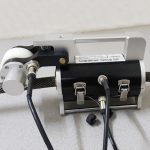
ELECTROMAGNETIC INSPECTIONS ALSO REFERRED TO AS NDT: this type of wire rope inspection gives detailed insight into the condition of a rope. Its reliability has made this type of testing largely a universally accepted method for the inspection of wire ropes running over sheaves.
The principle of Electromagnetic Inspections is to magnetically saturate a section of the wire rope as it passes through a set of permanent magnets. Sensors detect disturbances to the field, which are automatically adjusted to correct for any speed variations of the wire rope.
The signal is displayed as a graphical trace. The trace delivers three primary sets of information:
- The extent of the occurrence of broken wires
- Amount of rope diameter loss due to wearing and corrosion damage.
- A complete history of the wire rope is recorded over its working life
An electromagnetic wire rope technician can use the signal to detect the location of the degradation and make an assessment of severity using visual and Electromagnetic Inspections evidence.
The approximate reduction in rope strength can be very accurately assessed. Using this technique, the entire length of the wire rope can be tested and the complete cross-section of the rope examined.
Electromagnetic Inspections inspections will detect broken wires or corrosion damage on the inside of the rope not visible to external visual inspection. This includes a deterioration in plastic coated or infused wire ropes inner core.
When a crane is equipped with synthetic (plastic) sheaves or synthetic-lined steel sheaves, the inspector must carefully examine the rope for diameter reduction or lengthening of lay even if no visible damage is observed. Synthetic sheaves can greatly increase the contact area between the wire rope and sheave by cushioning the rope.
This cushioning effect causes the wire rope to wear internally at the core (wire rope operating on steel sheaves will first wear externally) before the damage is noted on the outer wires.
This is a very dangerous situation because internal wire breaks are hard to detect. Non-Destructive testing equipment aids in the detection of internal wire failures.
Without the appropriate tools, this places the inspector at a great disadvantage, therefore, he/she must be diligent in the detection of diameter reduction and lay lengthening to prevent catastrophic failure from internal core damage.
In versions of ISO 4309 standard, it describes a method of how to inspect the inner core of a wire rope by attaching clamps to open the outer layer of the wire rope. We strongly recommend that this method is not used by inexperienced LMI’s, Competent Person or Riggers as this inspection method can do more harm than good.
Referring to the discard numbers of wire breaks specified in the standard this refers to external wire breaks. Appraising the condition of a wire rope with internal breaks is therefore left to the inspector. But without the correct equipment this an impossible task, as the inspector only sees roughly 20% of the ropes metallic cross-sectional area.
While you can carry out daily pre-use checks of lifting equipment yourself you will need to have your equipment inspected by a Lifting Machine Inspector at least every six months. This is so that the cranes’ wire ropes can be provided with a certification stating that the equipment is safe to use. This will, of course, depend on the applicable local regulation/standards as well as the companie’s own safety standards.
SUMMARY
Wire rope deteriorates gradually throughout its entire service life so to keep abreast of deterioration, your wire rope must be periodically inspected. Because moderate deterioration is normally present the mere detection of any rope deterioration does not usually justify rope retirement. In the interest of safety, the owner/user of the crane/lifting equipment must employ the services of an inspector that is not only certified but qualified and possesses the correct equipment to perform the task required.
Regarding rope replacement, ISO 4309-17 states “only ropes of the correct length, construction type, direction of lay and strength, shall be used as specified by the crane manufacturer”. Please make certain that the equipment is inspected and tested following the relevant procedure. Safety is of the paramount as every accident is a warning that something is wrong with either the inspections, methods, material or the lack of training. Act before the incident as this is an ethical and moral duty and you have a legal responsibility for safety supervision.
Cranemec is a Lifting Machine Inspection and Testing Entity.