Over the past few months Cranemec has received several requests to explain the difference between Safe Working Load (SWL) and Working Load Limit (WLL). We have set out in this article to explain the difference.
The term Safe Working Load, (SWL) has been a term used by the engineering fraternity particularly with respect to load carrying equipment for many years.
It was generally considered to be the minimum breaking load of a component divided by an appropriate factor of safety giving a ‘safe’ load that can be carried or lifted.
Throughout the world the use of Safe Working Load (SWL) for cranes, hoists, winches and lifting gear was universally used throughout industries and referenced in the relevant legislation and standards.
Since the definition of “Safe Working Load” is not very specific and there are legal implications, the USA standards stopped using this term.
A few years later the European and ISO standards began to follow suit. The Americans, Europeans and ISO then developed a more appropriate term and definition for the maximum load capacity of a particular lifting device.
All parties agreed to the use of the term “Working Load Limit” or WLL.
So, what is Working Load Limit (WLL)? It is the most frequently used terminology used by manufacturers now tagging all load carrying equipment, rigging and its components with the abbreviation WLL (Working Load Limit). A simple definition of WLL is the maximum load that includes mass or force that should ever be applied to the load carrying equipment in a specified condition or application. Any rigging device or configuration is only as strong as its weakest or lowest WLL rated part. Remember, the WLL provides a safety margin to compensate for the weakening of the lifting equipment during normal use due to wear, ageing, dynamic loading, jolting during lifting and inaccuracies in load weight estimations.
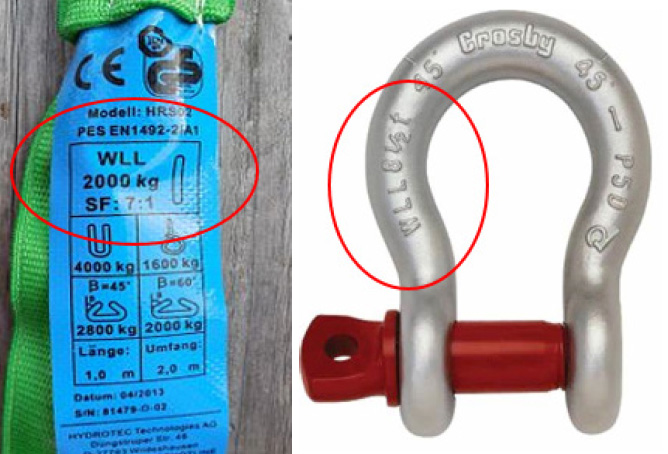
FIG. 1
It is the lifting equipment’s manufacturer that recommends the maximum load capacity of his lifting equipment. The lifting equipment or device can be a rope, a line, a crane, hooks, shackles, slings, or any other lifting device. To know the safe working load, the lifting equipment’s minimum breaking strength is divided with the safety factor that is constant or assigned to a particular type of equipment.
Usually, the safety factor of a particular equipment ranges from 4 to 7 but of course this depends on local legislation.
If the equipment poses a risk to a person’s life, the safety factor should be increased. (FIG 1)
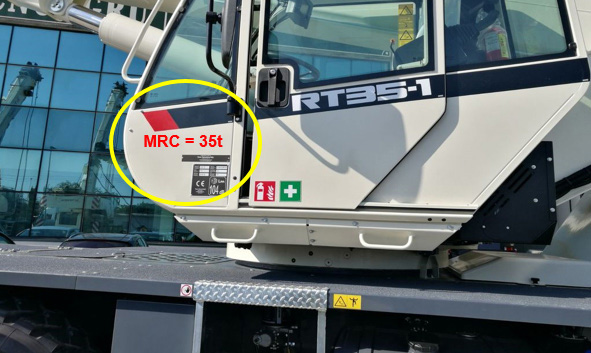
In the case of cranes, hoists and winches, the term Safe Working Load (SWL) has been replaced by Manufacturer’s Rated Capacity (MRC), which is the maximum gross load which may be applied to the crane, hoist or lifting attachment while in a particular working configuration and under a particular condition of use. This may include any piece of lifting equipment that operates with variable jib lengths.
Refer to the machines manufacturers Rated Capacity Chart which will have all the necessary information regarding the machines lifting capacity including weights of load hooks and any accessories fitted on the machine.
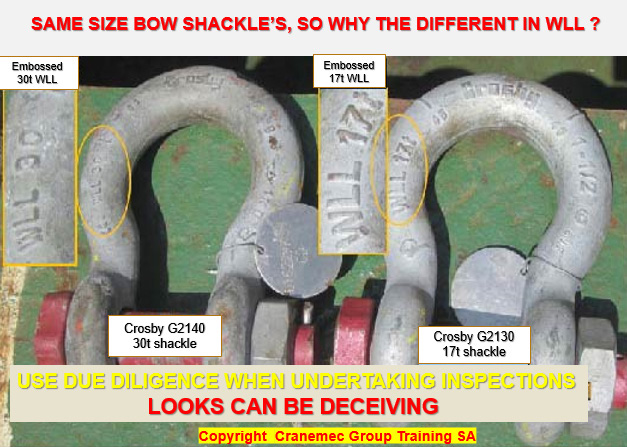
FIG. 2
In summary
- Safe Working Load is the older term of Working Load Limit.
- SWL has been phased out and should no longer be used, and all reasonable practicable efforts should be made to replace SWL with WLL.
- MRC should be used for all machines that operate with variable jib lengths e.g cranes, telehandlers, hoists and winches etc. The MRC must be clearly labelled on both sides of the lifting machine
- WLL should be used for all lifting devices. Allowance must be taken into consideration for the arrangement of the lifting devices by derating the WLL.
Important note: WLL embossed on equipment. To make it more difficult, what you see is not what you think you are getting. The competent person or rigger must use due diligent when selecting loose lifting gear. (FIG 2)
Cranemec is an Engineering Council (ECSA) accredited Lifting Gear Inspection (CPD) training facilitator, as well as provides a comprehensive inspection and certification service on a variety of lifting machines/ equipment.